

Continuous Fault Monitoring
Continuous Fault Monitoring
NF31
As New Zealand’s distribution networks face the dual pressures of aging infrastructure and intensifying weather patterns, the transition to persistent, 24/7 fault surveillance is no longer optional. EDBs must move beyond the traditional "break-fix" cycle, where the first notification of an issue is often a customer phone call. Implementing a continuous monitoring layer allows for the immediate detection of anomalies, ensuring that network health is measured in real-time rather than through historical outage data.
This shift toward automated network intelligence transforms how control rooms interpret feeder behavior. By capturing and analyzing every disturbance, operators gain a comprehensive view of localized stressors that precede a total loss of supply. This constant stream of data provides a live map of network vulnerability, allowing for the prioritization of resources based on the actual physical state of the equipment rather than theoretical replacement cycles.
Nexbe’s NF31 provides this critical operational awareness by functioning as an early-warning system that detects incipient failure signatures. Unlike standard protection relays, it identifies "pre-fault" conditions—such as intermittent arcing, tracking on insulators, or cable degradation—well before they escalate into sustained outages. By categorizing these specific transient events, the NF31 enables field teams to conduct targeted "surgical" repairs during daylight hours, drastically reducing the reliance on expensive, high-pressure emergency responses in the middle of the night.
Ultimately, the NF31 empowers EDBs to achieve a self-healing perspective through precise locational data and automated triage. By distinguishing between momentary environmental interference and genuine hardware fatigue, the device eliminates redundant patrols and streamlines fault-finding missions. This intelligent oversight not only improves reliability metrics like SAIDI and SAIFI but also significantly bolsters public safety by identifying high-risk conditions—such as fallen conductors or failing neutrals—the moment they occur.
Please contact us to discuss your network requirements - Contact
Thank you.
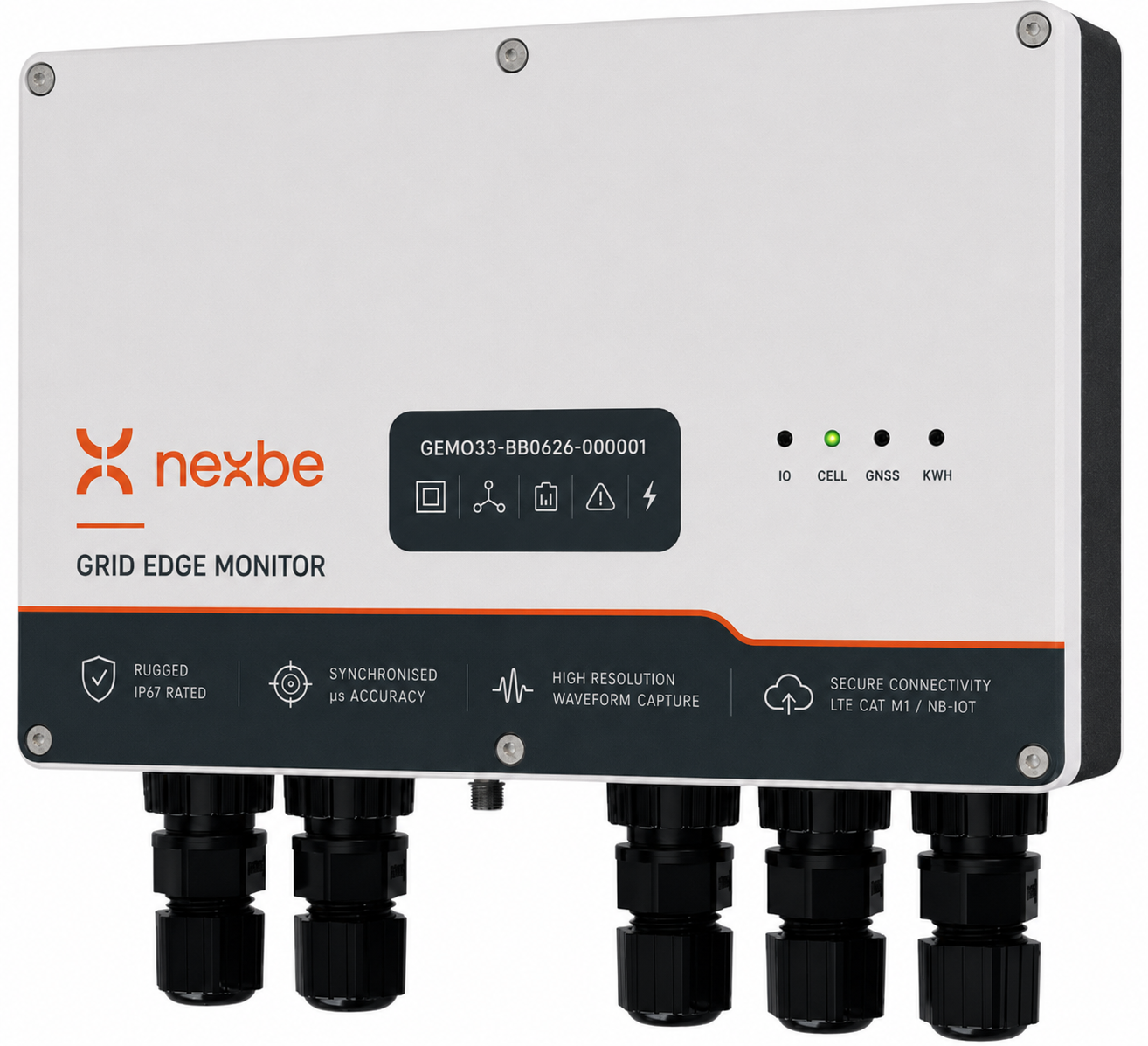
Measures three-phase and neutral current using Rogowski coil sensors.
Captures high-speed synchronised waveforms with GNSS timing accuracy down to 1 μs.
Supports standards-compliant power quality, energy, and event reporting.
Estimates supply impedance to monitor connection integrity and detect degradation.
Performs high-frequency EMI and wavelet analysis to detect arcing, vegetation contact, and partial discharge events.